


 Cart
Cart
 sales@molnova.com



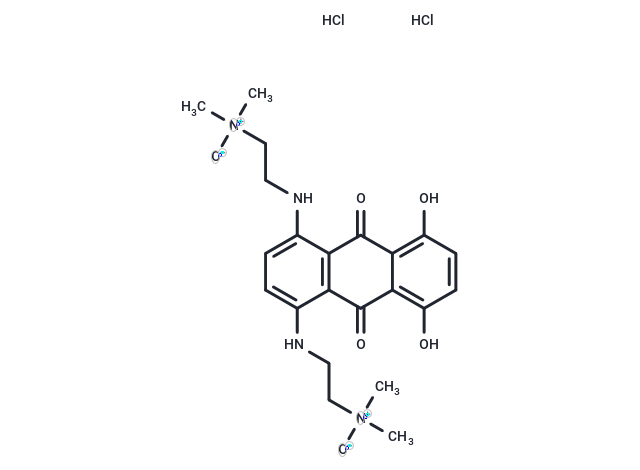
Banoxantrone dihydrochloride
CAS No. 252979-56-9
Banoxantrone dihydrochloride( —— )
Catalog No. M32797 CAS No. 252979-56-9
Banoxantrone dihydrochloride (AQ4N dihydrochloride) is a novel hypoxic cytotoxin that selectively kills hypoxic cells through an iNOS-dependent mechanism.
Purity : >98% (HPLC)
 COA
Datasheet
HNMR
HPLC
MSDS
Handing Instructions
COA
Datasheet
HNMR
HPLC
MSDS
Handing Instructions
| Size | Price / USD | Stock | Quantity |
| 5MG | 68 | Get Quote |


|
| 10MG | 93 | Get Quote |
|
| 25MG | 155 | Get Quote |
|
| 50MG | 227 | Get Quote |
|
| 100MG | 329 | Get Quote |
|
| 500MG | 788 | Get Quote |
|
| 1G | Get Quote | Get Quote |
|
Biological Information
-
Product NameBanoxantrone dihydrochloride
-
NoteResearch use only, not for human use.
-
Brief DescriptionBanoxantrone dihydrochloride (AQ4N dihydrochloride) is a novel hypoxic cytotoxin that selectively kills hypoxic cells through an iNOS-dependent mechanism.
-
DescriptionBanoxantrone dihydrochloride is a novel bioreductive agent that can be reduced to a stable, DNA-affinic compound AQ4, which is a potent topoisomerase II inhibitor.
-
In VitroBanoxantrone (AQ4N) can be reduced in a hypoxic environment to a stable DNA-affinic agent AQ4. AQ4, a potent topoisomerase II inhibitor, would be capable of damaging cells recruited into the cell cycle following radiation damage to the well-oxygenated cells of the tumor. Banoxantrone shows more than 8-fold higher cytotoxicity under hypoxia than normoxia in cultures of 9L rat gliosarcoma and H460 human non-small-cell lung carcinoma cells but not for 11 other human cancer cell lines. DT-diaphorase protein levels and banoxantrone chemosensitivity are poorly correlated across the cancer cell line panel, and banoxantrone chemosensitivity is not affected by DT-diaphorase inhibitors.Banoxantrone is a bis-N-oxide that is reduced via two sequential two-electron reductions to the tertiary amine, AQ4, which is a potent cytotoxic agent toward both aerobic and hypoxic cells. AQ4, but not AQ4N, intercalates in DNA with high affinity to generate a stable persistent complex that can inhibit topoisomerase II and cause DNA damage and cell death.
-
In VivoBanoxantrone (200 mg/kg) significantly enhances the tumor growth delay caused by radiation. This occurred when radiation is administered both as a single dose (12 Gy) and in a multifraction regimen (5x3 Gy). A study of the scheduling of Banoxantrone (AQ4N) administration shows that there is a very long time period over which a maximal effect can be elicited (drug given 4 days before to 6 h after radiation). These results suggest that Banoxantrone has significant potential as a bioreductive drug. The activation of banoxantrone cytotoxicity in vivo requires tumor hypoxia that is more extensive or prolonged than can readily be achieved by vasodilation or by antiangiogenic drug treatment. Incorporation of banoxantrone into conventional chemoradiation protocols therefore targets both oxygenated and hypoxic regions of tumors, and potentially will increase the effectiveness of therapy. A single dose of 60 mg/kg banoxantrone enhances the response of RT112 (bladder) and Calu-6 (lung) xenografts to treatment with cisplatin and radiation therapy.Banoxantrone will increase the efficacy of chemoradiotherapy in preclinical models.
-
Synonyms——
-
PathwayImmunology/Inflammation
-
TargetNOS
-
RecptorNOS
-
Research Area——
-
Indication——
Chemical Information
-
CAS Number252979-56-9
-
Formula Weight517.4
-
Molecular FormulaC22H30Cl2N4O6
-
Purity>98% (HPLC)
-
SolubilityIn Vitro:?DMSO : 25 mg/mL (48.32 mM; Ultrasonic ) H2O: 20 mg/mL (38.65 mM; Ultrasonic)
-
SMILESCl.Cl.C[N+](C)([O-])CCNc1ccc(NCC[N+](C)(C)[O-])c2C(=O)c3c(O)ccc(O)c3C(=O)c12
-
Chemical Name——
Shipping & Storage Information
-
Storage(-20℃)
-
ShippingWith Ice Pack
-
Stability≥ 2 years
Reference
1. Hejmadi MV, et al. DNA damage following combination of radiation with the bioreductive drug AQ4N: possible selective toxicity to oxic and hypoxic tumour cells. Br J Cancer. 1996 Feb;73(4):499-505.?
molnova catalog



related products
-
Cindunistat
Cindunistat (free base) is an orally available selective iNOS inhibitor for the study of arthritis.
-
iNOS-IN-14
iNOS-IN-14 (3-bromo-1H-indazole-7-carbonitrile) is a potent nitric oxide synthase (NOS) inhibitor that inhibits the NADPH oxidase activity of nNOS.
-
3,4-O-Isopropylidene...
3,4-Oxo- isopropylidene-shikimic acid has significant anti-inflammatory, anti-thrombosis, antioxidant, analgesic effects, it has protective effects on experimental colitis induced by trinitrobenzenesulfonic acid in rats, probably due to antioxidant action.
